
When I was still a manager of a tech company, one of my key consultants complained of not receiving the profit share level promised a year ago by the President of the company. As a manager, I felt obliged to protect the company and its officers. I argued to my subordinate that we should just be patient. What he said in response struck me deep to this day.
He said that unlike other people who had other means of livelihood, had huge savings or who probably earned more than him, he had no other source of revenue except for this job. He explained to me that he took those promises seriously and planned his future based on the previous year's prononouncements, and he was in a bind because of it. All of this, in spite of the fact that my group had met our deliverables.
I then understood that one cannot make empty promises, for those words do affect the lives of people in a sometimes significant way. It was then that I realized that people's circumstances are different from each other, and one cannot assume to understand another person's condition.
Reading the news header a few days ago on our public school teachers delayed P1,000 poll allowance, I cannot help but empathize, no matter how small I THOUGHT the amount was.
05 January 2008


03 January 2008
What If
Being such the pack rat that I am, I sometimes meditate on how different it would be for me if I were in a completely unimaginable situation, something I would normally choose not to think about.
How would I feel if I suddenly had no money at all, no possessions, no friends and no family;
What if I lost them all?
What if I lost them all?
Or if I now had to beg for alms or food, and someone I knew saw me? And all the food I could eat would be leftovers, spoiled and dirty.
Or if I didn't have a roof over my head and I was forced to sleep in the dump --- rain or shine? No toilets, no showers, no soap, no toiletries, no clean water, no laundered clothes; Stinking to high heavens.
Basically having nothing, no one and not even my good health.
With no one to care for me if I got sick and couldn't move even to help myself.
With some form of pain that never goes away.
Worse, what if I were a vegetable, paralyzed and no one around for me?
And to add to the pain of it all, being in this position after growing up not wanting much.
It kind of makes you think, doesn't it?
Of how blessed and fortunate we are. To have food, a home and loved ones that love you back --- whatever the kind.
But of how at the end of our lives, these are the very same things we need to let go of anyway --- our health, wealth and loved ones.
In a more practical sense, I think exercises like this remind us that we are, after all, no different from one another. The only difference being money, something you leave behind when you die, should be no valid point of differentiation. But sadly, it is.
The best we can do, really, is to count our blessings and give as much as we can to uplift the lives of those less fortunate than us.
This New Year, my call to action for you is: "Let us get rid of all our excesses and deposit them where they are needed most."
And more importantly, to "Learn to slowly let go of all our worldly connections, for we will anyway have to do so someday"
(Blog Composed and Posted from somewhere in the world on my BlackBerry Wireless Handheld)
28 December 2007
Lessons from the Lanzones

Today, looking at all the fruits we received as gifts from friends, such as apples, pears, pomelos, dragon fruit, persimmon and grapes, I wondered why no one bothered to give out local fruits as gifts for Christmas. Even the pomelo was imported. Where were all the locally available fruit? To my knowledge, pears, apples and persimmon still do not grow in the tropical climate of the Philippines.
In my mind, I went through all our local fruits and the various ways we usually eat them at home:
- Mangosteen: We in our clan, for some reason, call this as "Mango-stan". My favorite fruit! Since I was a kid, I would feel that all that thick purple rind was such a waste for it is usually thrown away. Now we know of its natural curative properties, even for Cancer.

- Balimbing (Star fruit): As seen in the picture above, of a still unripe and green Balimbing, we still have a tree of this in Pasig. This is so good when it is ripe. Say no to the giant ones found in markets these days, they just don't have the same flavor. Say no to real-life political balimbings as well, hehe.
- Siniguelas (Spanish Plum): As we were growing up, our 'katiwala' in Binangonan would bring 'kaings' of these small fruit to our home from our farm. My mom prefers the slightly raw and crunchier fruit, I prefer the fully ripe, softer ones.
- Lanzones: You can't stop eating this once you've started. A word of advice though, don't eat it on an empty stomach, unless you're constipated. Major laxative! You can also smoke dried lanzones peels to drive away mosquitoes. No, you don't smoke it like a cigarette, you burn it and just allow it to smoke. Duh.
- Duhat (Java Plum): We had a huge tree of this in Binangonan. We would place them in a sealed container with a little rock salt and shake them vigorously, afterwhich, voila! Non-stop duhat eating. The salt hides the somewhat bitter taste while all the shaking tenderizes, and I swear, sweetens them. They make this into wine too, though I have never tried it.
- Kasuy (Cashew): I think I am allergic to the nuts, my tongue hurts for days after, but the fruits are wonderful! What is better are the young leaves of the tree. Eat them raw with some spicy, fried dish. It is bitter, but
- Pinya (Pineapple): I don't particularly like this fruit because I usually eat my fruits either first thing in the morning or right before meals, on an empty stomach, and this fruit always gives me major acid problems. I have only tried one variety of pinya that I ever liked, and that was at the Dole plantation, and it is for export only.
- Durian: Ah, the fruit you either hate or love. Well, I loooovvvve digging into them with my bare hands! I love its texture, its taste, everything about it, including its smell. Admittedly, I was impartial to this fruit, and even disapproved of its smell, that is until I tasted a fresh durian with my bare hands in Davao. Alas, the love affair commenced...
- Santol: There are sweet santol and there are sour santol. I, proudly state, that I have uses for both kinds. Unlike others who enjoy allowing the santol seed to swim gleefully in their mouths, I would rather leave some 'hacked' whole fruits in a jug of water overnight in the ref for a refreshing drink the following day. As for the sour fruits, which most people neglect because they are 'inedible', I discard the seeds, grate the inner part of the rind, ferment in salt for a few days, and cook with chilis and coconut milk for an appetizing entree. I'm serious!

- Kamias: As in the picture above, our Kamias tree grows next to our Bayabas tree, and if you look closely, can see the the fruits of the Bayabas in the background and the Kamias bunch in the foreground. My Lola used to make candies out of these Kamias fruits. As kids, we would also eat them as-is, with a pinch of MSG (Oooh, we didn't know they were bad then). Its sourness would really make our mouths water. Kamias is also wonderful as a souring agent for sinigang, provided it is done properly. I remember my lola instructing us to clean our hands with mashed-up Kamias fruits, as she often did. It was supposedly a good hand cleanser.
Bayabas (Guava) - Have you ever tried the local 'manibalang' guavas, the ones not as large as the imported varieties? Well, you should! I was mostly indoctrinated on the imported ones, which I found hard to eat with all the seeds and really, it wasn't all that tasty. On top of that, guava cooked in sinigang actually doesn't appeal to my sense of smell. That is, until I chanced upon one of the help in our Tagaytay farm meandering beneath a guava tree, muching the time away. I got curious and tried that small yellow-green orb of a fruit, and it was like..."where have you been all my life?". It has to be 'manibalang' or at that point in its maturity where it borders between being too crunchy and too soft, or just right....right? I started appreciating sinigang sa baybas as well...
- Langka (Jackfruit): Eaten ripe or... taken from the tree while still immature, chopped into bite size pieces and broiled in coconut milk. Ginataang Langka! "Kamansi" or Breadfruit is another fruit which tastes good prepared the same way as immature Langka. Try freezing ripe Langka so it stays longer. Then, when craving for some, just pull some from the freezer.
- Avocado: We have an avocado tree which we regularly take from, and anticipate all year round. The kids, wife and I love Avocado mashed with milk and sugar, then frozen. The leaves, we use for tea. I learned this from an old-timer I caught picking fresh leaves.
- Dalandan: Among all the citrus fruits, I love this the best. It is great eaten as it is, or juiced and mixed with pandan water. I swear, I can tell even while blindfolded, if the citrus scent is from a Dalandan, Pomelo, Calamansi or Orange. Its scent is definitely unique and easy on my palate --- not too tangy, not too sour.
- Kaimito: Has everyone tried Kaimito? Chilled? As is? I really like this fruit, I can gobble up several pieces at a sitting. The tree in our backyard is testament to our prolific want of the fruit. You can still see wooden stairs, sungkit and nets leaning against our trees.
And there are others: tiyesa, marang, mabolo (which I still need to try) and all the rest of the clan... I love you all!
Considering that the mango and watermelon are probably out of season, I just tried imagining how good and juicy they tasted when they were still around during this past year.
I enjoy discovering new fruit varieties, specially the ones endemic to a certain location. I once met a certain Dr. Coronel who was an expert in Philippine trees and fruits. He operates a nursery in Los Banos. It was there that I formulated the concept that what is good for you to eat depends on what grows where you live and what is available at that point in time. Watermelons, for example, seem to do a good job of replenishing lost body fluids and minerals during the summer months, when they are naturally available.
Back in Subic Bay, there was this tree that bore fruits similar to a longan. Upon opening, you were greeted with a large seed with thin-paperlike sweet flesh covering it. That was the edible part. I saw the monkeys eating it, so I ate it too. I later learned of the tree's name, which escapes me now, and that it only bore fruit every five years. Lucky me, I thought.
I just noticed that my grnadmother's old cacao tree is packed with fruits. I was told that one could eat the flesh like a santol. I think I'll go and try some...
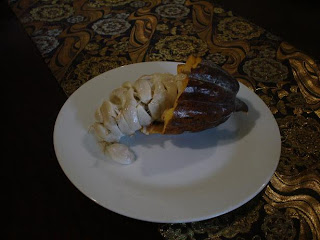 Yum....eaten just like Santol.
Oh, and the lesson from the Lanzones?
Not so long ago, when I learned that it took at least 15 to 20 years for a Lanzones seedling to bear fruit, I quickly remarked that it was not worth the wait to plant them. Even the economics probably wouldn't work out. I was then told, "It is not for us, but for our children. If everyone thought that way, we wouldn't be enjoying Lanzones right now."
Aha! I was dumbfounded. Barado! Guilty! Guilty!
(Topmost photo: Cacao/Cocoa Fruit; All photos taken from my Lola's backyard. Sorry, no picture of the Lanzones, we don't have a tree of it.)
24 December 2007
Christmas Cheers!
Before I get drunk tonight and lose my ability to write meaningfully, or carry on a decent narrative, let me take this opportunity to greet one and all a special Christmas. Instead of reminiscing on all the great times gone by, and how things were so much better before, my wish for all is that before we let this season pass us by, let us all make this our best Christmas yet.
Christmas time is merry-making time with our loved ones, and that is what makes us long for Christmas the whole year round.
A Happy, Memorable and Joyful Christmas to all!
Christmas time is merry-making time with our loved ones, and that is what makes us long for Christmas the whole year round.
A Happy, Memorable and Joyful Christmas to all!
20 December 2007
The Peculiarity of the Philippine Language

It is difficult to remove biases, especially when these involve differences based on individual's geographical origins. Language, for one, often betrays one's roots which in turn serve as someone else's preconceieved notions about the person. The way one speaks is sometimes a cause for discrimination.
Particularly in the Philippines, the reason why a person from one region pronounces the same word differently from someone from another part of the country may then come as a surprise to you.
Did you know that the original Philippine alphabet, most likely the foundation of all our contemporary dialects, called 'Baybayin' or more commonly known as 'Alibata', only had three vowels? Yes, just three.
They are "A", "E or I" and "O or U". E or I? O or U? Yes, the use of "E" and "I" are interchangeable, and so is the use of "O" and "U"
This accounts for why both "Lalake" and "Lalaki" are acceptable pronunciations of the same word. And so with: Kain and Kaen, Multo and Molto, Diyos and Deyos, Laki and Lake.
So, the next time you hear a person from a different region as yours pronounce the word "kuya" as "koya", or vise versa, think hard about who is correct. In this case, both of you are.
Particularly in the Philippines, the reason why a person from one region pronounces the same word differently from someone from another part of the country may then come as a surprise to you.
Did you know that the original Philippine alphabet, most likely the foundation of all our contemporary dialects, called 'Baybayin' or more commonly known as 'Alibata', only had three vowels? Yes, just three.
They are "A", "E or I" and "O or U". E or I? O or U? Yes, the use of "E" and "I" are interchangeable, and so is the use of "O" and "U"
This accounts for why both "Lalake" and "Lalaki" are acceptable pronunciations of the same word. And so with: Kain and Kaen, Multo and Molto, Diyos and Deyos, Laki and Lake.
So, the next time you hear a person from a different region as yours pronounce the word "kuya" as "koya", or vise versa, think hard about who is correct. In this case, both of you are.
Subscribe to:
Posts (Atom)


